|
|
Last year before the WIA annual event I posted “Covington, Kentucky, 1913: A Family Mystery” (which can be read here). This extensive post brings my research into the history of my father and prolific American inventor, C. W. Vogt (1891-1973), up to date, with archival photos and documents.
Vogt Family Background
It is worthwhile to get a broader picture of his background than I have previously provided. The military invention we will look at is the result of his being exposed to the intricacy of timepieces and high level mechanical engineering.
 Adam Vogt
His father, Adam Vogt , was an horologist (clockmaker and repairer) and jeweler. It was said of my father Clarence that after Christmas there wouldn’t be a toy not taken apart and analyzed, as he did at age five with his first watch.

Adam was also involved in real estate and manufacturing. He and his brother Henry Vogt were Notable Men in Louisville. Their joint company was Vogt Brothers Manufacturing.

Fire hydrants produced there still dot our landscape.
 Vogt Bros. Hydrant. Photo courtesy of Mike Martin. A young C. W. invented for them a coal stoker and coal crusher, both of which failed.
Henry Vogt
 1901 Sir Knight Henry Vogt, Knights templar started his own dynastic company, the Henry Vogt Machine Company.
 The Henry Vogt Machine Company.

It became a leader in valves and refrigeration.
For a cool look at a salesman’s travel book for them click here.
C. W. Vogt
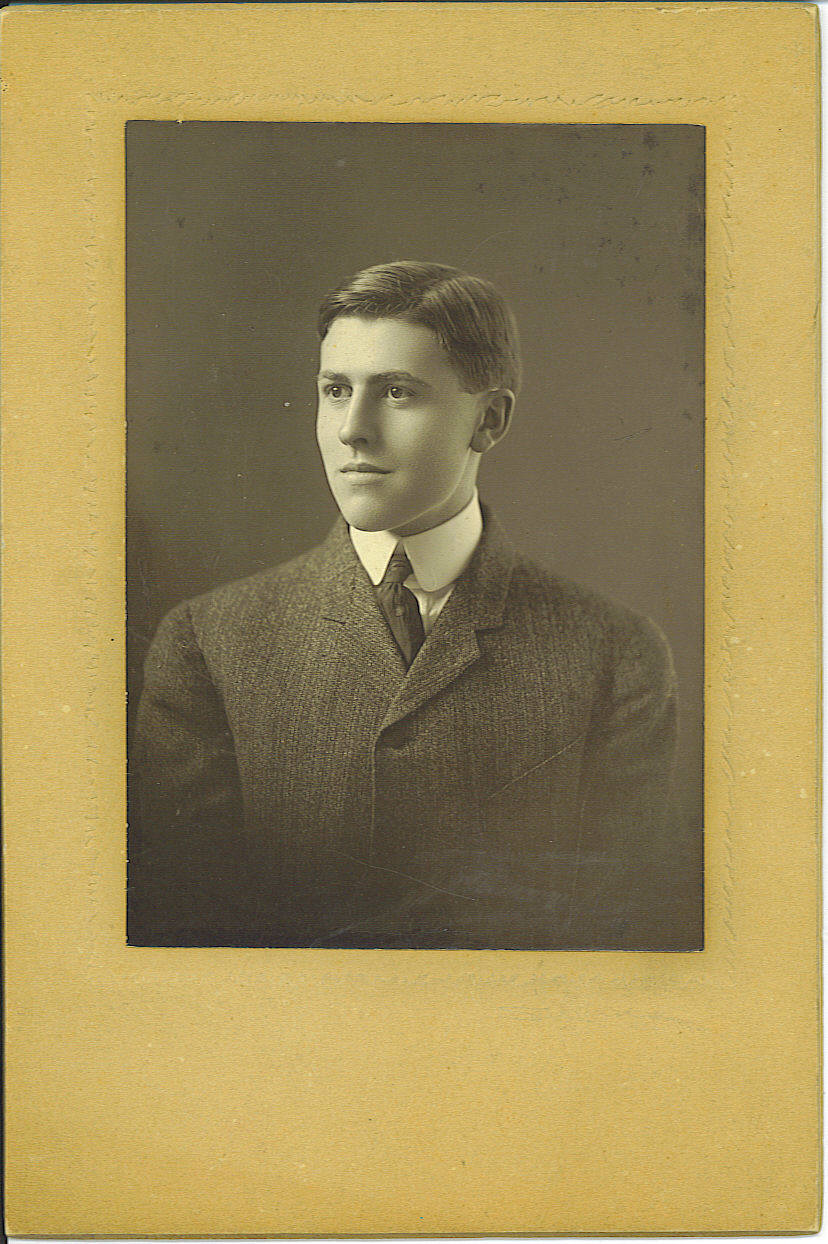
 C. W. Vogt youthful portrait
attended Cornell University for two years, absorbed what education he felt they could offer him, and then went to work for Vogt Brothers and the Henry Vogt Machine Company. He developed a strong dislike for his uncle. Upon asking for a raise he was told that until he could do every job in the plant better and faster than everyone on the shop floor, no promotion was possible. Talk about Old School…
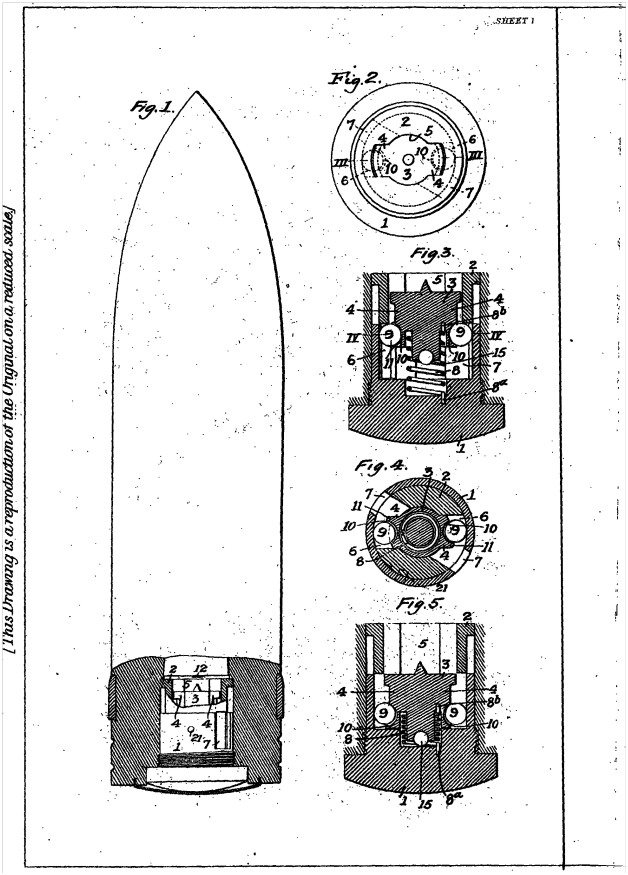
Delay detonation mechanism.
It was likely that during this time he began work on his military invention. The trip to England in 1914, mentioned in the previous post, could have well been related to its early development. The first reference I’ve found, below, reveals the process to have taken years:
From “Industrial Refrigeration” Volumes 54-55 February 1918
“Clarence Vogt, of Louisville, Kentucky, in recognition of his work in perfecting a time explosive on which government authorities have been working five years, has been made a captain in the United States regular army. Captain Vogt’s invention has an automatic delayed firing mechanism for high explosive shells and is covered by forty claims. Up to the time of enlisting in the Ordinance Department last August practically all of his time was devoted to the refrigerating line. By reason of his being a member of the American Society of Engineers, Capt. Vogt was qualified for appointment as first lieutenant without having to study at a training camp. He is the son of Mr. Adam Vogt, president of the Vogt Brothers Mfg. Co., of Louisville, and was manager of that company at the time he joined the colors. Captain Vogt is twenty- six years of age.”
 Capt. C. W. Vogt. Here is a short section of text followed by drawings of the device. If anybody with solid engineering savvy wants to read the complete text I’ll be happy to furnish them the whole patent. I am as baffled now reading through the pages as I was in 1965 when he showed them to me in England!




Clarence Vogt brings ice cream machinery into the 20th century.
“The crank, industrial crank, mold, disher and shallow freezer all came into use by the end of the 19th century, but one more innovation bears mentioning. In 1926, Louisville, Kentucky, inventor Clarence Vogt designed and built the first continuous process freezer, bringing the mass production of ice cream products full circle.” eHow.com.
I grew up hearing about his role as inventor of the process for creating continuous frozen ice cream and other food products but until recently there was no documentation. This recently uncovered clipping from the Courier Journal is the first public announcement of his revolutionary invention which would become the “Votator”.
Louisville Courier Journal March 5, 1926.
“INSTANT FREEZER TO REVOLUTIONIZE ICE CREAM INDUSTRY, LOUISVILLIAN SAYS.
” Something new has been accomplished in Louisville in freezing liquids, which will revolutionize the ice cream industry and provide a new business for the city, according to C. W. Vogt, inventor and refrigeration expert, who heads a company recently formed for the manufacture of his machines. Mr. Vogt made the announcement Sunday.
The new process can not only be used in ice cream manufacture, but is also applicable to other lines, including the freezing of eggs, proper chilling of lard and other materials, he said.
The apparatus, according to its inventor, saves 80 percent of the space now being devoted to ice cream machines, saves 50 percent of the labor involved, and in addition is instant and continuous. Through the old system of ice cream manufacture Mr. Vogt said twenty-four or more hours were required to prepare cream for the market after it was frozen.
Makes any amount
Mr. Vogt’s machines will make from a small quantity to 600 gallons an hour and the cream is ready for consumption as soon as it runs from the spigot of the new machine. Fifteen patents in all have been applied for on the principles evolved by Mr. Vogt. The smaller machines now being manufactured by the Standard Sanitary Manufacturing Company and the Louisville Electric And Manufacturing Company, suitable for hotel use, will supply instant cream for large banquets and the hotel trade as well.
A mixture of the cream is inserted in the machine, it passes through a rather small tube which is connected to the ordinary refrigeration system and comes out of the spigot at the turn of a switch. The mixture is under pressure and the air is supplied by a small piston. The mixture is under a continuous pressure of about fifty pounds.
As it passes through the tube, for a distance of two feet, it is agitated by a special contrivance which touches no metal part of the machine and thus does not produce frictional heat. At the end of the tube near the delivery spigot, the tube widens and the agitator moves faster, due to the greater diameter of the paddles. The brine is controlled automatically to insure proper temperature.
Manufactures See It
The contrivance produces more cream from a given mixture than any yet evolved, Mr. Vogt said, because it saves waste. Not only does it save waste, but one kind of mixture can be put in as soon as the other has run out. Thus, he said, it is possible to run through two or more flavors in succession without halting the operation of the machine. It fills directly to cups, mold, or any sort of container.
Due to the rapidity of freezing and the continuous agitation under pressure, the flavor and homogeniety of the mixture is retained, he said. The machine is the forerunner of others which will be developed later, he said.
Ice cream manufacturers from the Middle West and the South have been drawn to Louisville by the demonstrations given here during the last two or three months. Several large concerns have become interested in the process and indicate that they will freeze eggs and other products by the machines as soon as they can be produced, Mr. Vogt said.
The first machine will be delivered this week to a Louisville caterer. This machine takes no more space than an ordinary small table and will be able to produce the product continuously. Mr. Vogt said any of the machines can be operated by low-powered motors and are so simple that they can be installed anywhere there is a refrigerating system and an electric light circuit.
Chemical Tests Made.
Tests are being made in laboratories to determine whether the new machine has improved the product by adding new values to the frozen foods, Mr. Vogt said. A company has been formed by Louisville capital to exploit the machine. Mr. Vogt is president and general manager; David C. Liggett, vice-president and sales manager; C. B. Kniskern, secretary and treasurer and G. O. Wymond, sales engineer. The board of directors consist of Richard Bean, Lee Miles, A. W. Lissauer, Louis Hollenbach, Walter H. Girdler, Arthur H. Almstead, and Mr. Vogt. No stock is being sold by the company, which is a closed corporation, it was announced.
Other uses later will be made of the principles discovered here, it was said. After careful surveys and consultations, Mr. Vogt said, it developed that no previous use had been made of the principle involved in the process.”
Board member Walter H. Girdler was himself the founder of a dynastic corporation bearing his family name. In following years the Girdler Corporation developed the Votator. It brought them fame and success in the food industry.
C. W‘s comments about his invention, that “other uses later will be made of the principles discovered here” and that it would “provide a new business for the city,” were clearly born out in this advertisement from 1947.

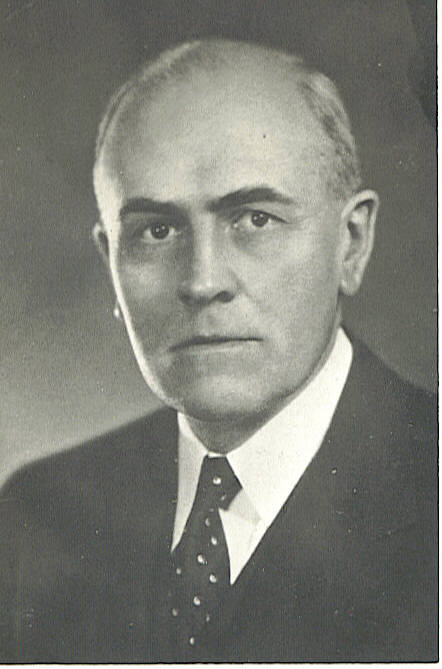
My father went to work for the Girdlers. Here is a fine portrait of him as vice-president of the Votator division.

He struck off on his own within a few years. More ice cream inventions followed. Working with the Reynolds Aluminum Company he combined his expertise in refrigeration and packaging in the mass production of the Eskimo Pie.
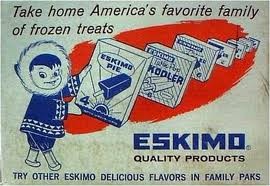
Later he developed the MelORols.
 Mello- Roll
C. W. Vogt enjoyed a long, successful life as a development engineer and inventor. His mind brimmed with ideas. He brought an amazing number of them to fruition.
Acknowledgements.
I would like to thank:
Charles Winheld, a literal stranger on a train, who kindly assisted me in negotiating my father’s patents on the US Patent Offices data base. (220 patents from 1925 to1971- click here to see them) and got the ball rolling for me.
Gary Falk, writer, musician, and historian from Louisville who has written extensively on the Girdlers. He betook himself to visit the Free Library and photocopy the newspaper article about the Votator, which otherwise would not have come to light.
My sister, Sarah Vogt, whose brilliant research on European databases uncovered the delay- action patent. She has also contributed photos, links, and lots of enthusiasm.
Duke Briscoe for much appreciated technical computer help.
Emily Postma, C. W.’s first daughter and my half-sister. She sent me Buddy’s (her name for our father) high school/college scrap book last year, and, through our many conversations, helped me get a handle on the personal side of his life during his highly productive years of the 30s and 40s.
Vogt Toolworks. Does that sound familiar to you? Have you heard that name before? I hadn’t either until this afternoon. Talking to Don Schroder, the Artistic director at Popular Woodworking, about possibly signing up for the Woodworking in America event this fall to offer my fledgling shooting board and a few other items to the tool buying public, he said “Tico, your company name, TicoVogt.com, provides you with no identity.” Existential coup number one. “Plus, nobody will know how to pronounce your name.” Is this new information? I recalled a diving competition I was in where I missed my dive because of the botched attempt by the announcer to identify the next contestant.”Tick Vogggtee.” Nice.
Just for the record: Tico sounds like chico. The name Vogt, pronounced “auf deutch” sounds like a blend of “oat” and “ought,” preceded by an “f.” In English it has a hard sound, as in what you, presumably, do to elect the president. It translates as “provost” or “marshal,” and family lore has a “landsvogt, ” tax collector type of dude, requiring Wilhelm Tell to shoot the apple off of his son’s head. If you owe me money, you better pay up, or else.
Ron Brese has been encouraging me to pursue the Super Chute and other ideas and has suggested that the WIA extravaganza could be a “coming out party” to the woodworking community.
That is a phrase I’ve never used before in connection with my own, personal being, and it feels extremely awkward. I didn’t say that, okay?
The funny thing is, the connection with tool making in my family is gigantic. My Vogt grandparents and other relatives moved from Germany to Louisville, Kentucky during the reign of Bismark and immediately put their industrious talents and spirits to good use. My grandfather, Adam, and his brother, Henry, established Vogt Brothers Manufacturing, Vogt Freezers, and the Henry Vogt Machine company. They were pioneers in refrigeration technology and the quality of their products was renowned. I know Ben Cohen of “Ben and Jerry’s” fame, and he told me that the first freezer he bought starting out was a Vogt Freezer made in the 1930s and it worked perfectly.
My father Clarence W. Vogt (1891- 1973), age 63 when I was born, was one of America’s prolific inventors. As a Captain of Artillery in WW I he invented the delay detonation device for torpedo warheads. After the war he began a career as an inventor:
“Continuous Process Freezer: Around 1926, the first commercially successful continuous process freezer for ice cream was invented by Clarence Vogt.”~ inventors.about.com. Think: batch ice cream products with uniform air content and the self contained refrigeration in Good Humor trucks.
In the 30’s he was on the forefront of combining a new product, aluminum foil, with ice cream, utilizing it’s thermal and packaging capabilities. Think: Eskimo Pie.
His output of 220 US patents began in 1925 and lasted until 1971 .
He was well nigh retired when I came into this world but he was always at work creating things. His workshop was filled with odd pieces of prototypes, shelves of drawings, sealed aging yellow bags to test how long the liquid contents would stay confined and not leak. He invented scotch tape dispensers, had boxes of wooden blocks the shape of margarine sticks for which he created the wrapping technology.
His genius was way past my understanding. As a kid I liked to play with the compressor air hose because it was like a gun, the pine blocks for my toy army men, etc.
One thing I recall was a saying of his: “any damn fool can break something… but it takes a someone to make something.” He always appreciated things that worked well and valued the skill of the patternmakers, draftsmen, and metalworkers whom he hired to build prototypes for him.
I remember seeing pictures of his inventions inside buildings the size of warehouses and wondering “how can it all work?”
It will be with true humility and no little sense of sheepishness that I contemplate standing behind the name Vogt Toolworks, given this weight of family history.
Don, you rascal!

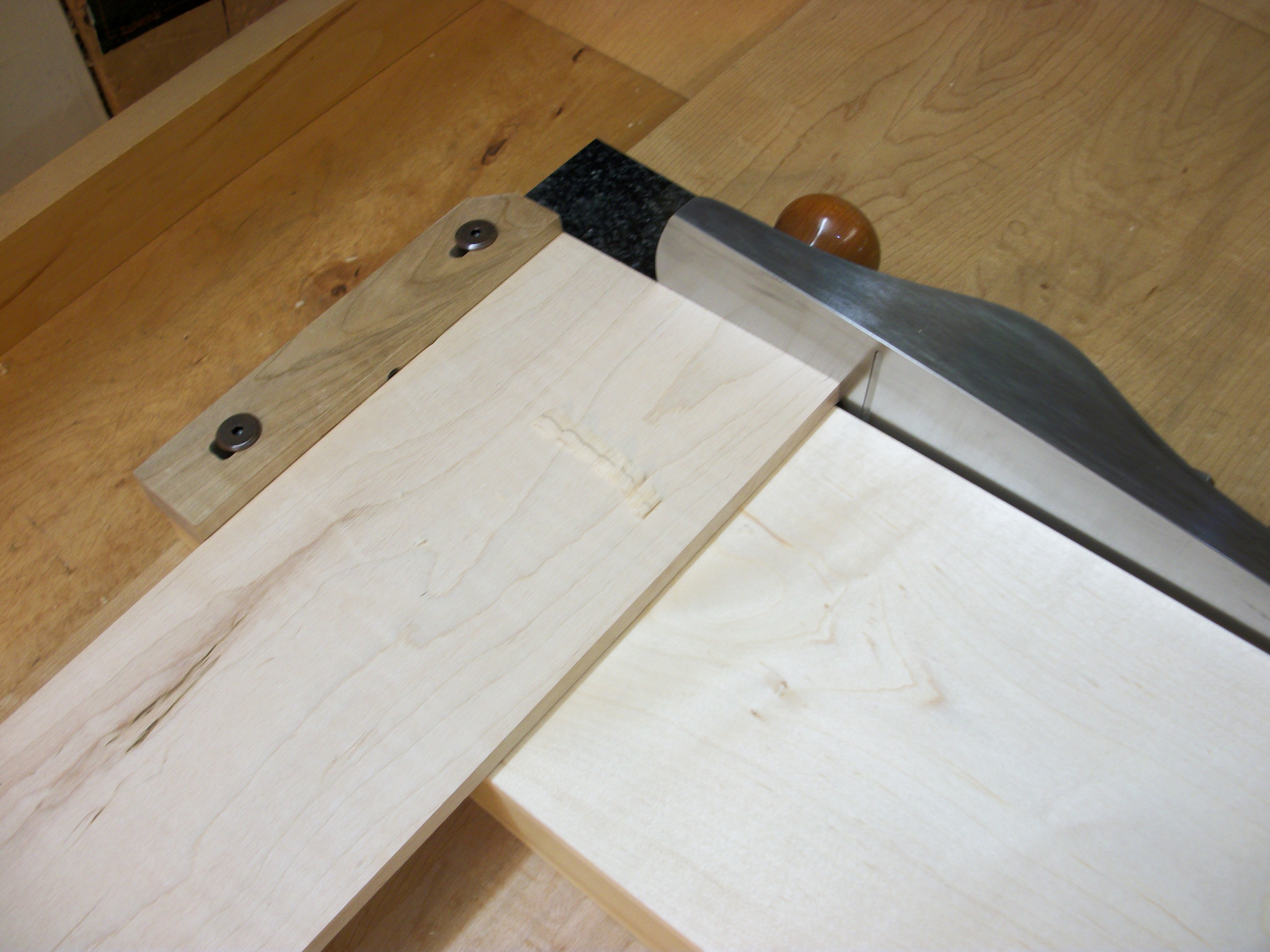
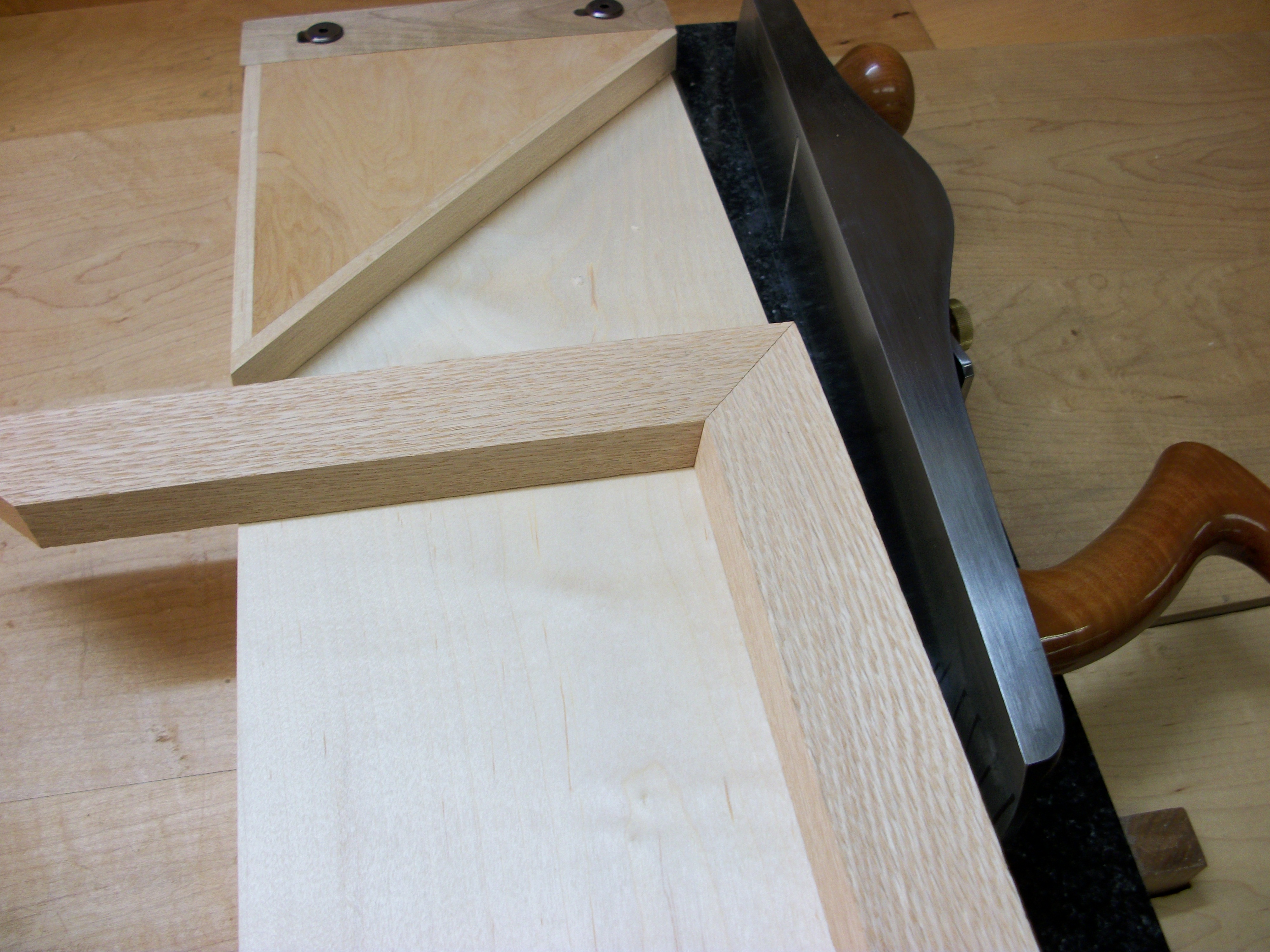
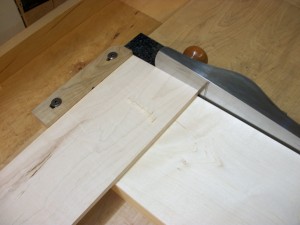 Precision Shooting For the benefit of my curious niece, Gina, who has asked “what’s a shooting board?” here is a definition and some pictures. From Webster: “(Joinery), a fixture used in planing or shooting the edge of a board, by means of which the plane is guided and the board held true.”
So, why the word “shoot” in reference to using a plane against the edge or end of a workpiece? Perhaps its origin is the word “chute,” an early device, like this one. Tom Fidgen has contributed this insight from a friend of his in the U.K and some in Australia who like the ramped board:
“They seem to like the ramp for not only the reduced wear on the iron but they seem to especially like the mechanics of the ‘chute action’..instead of the horizontal push and pull it’s the down hill or falling motion..a’ chute’ like a slide or water fall- the ramp really starts making sense when we think of it with those other images.”
In woodworking parlance edges and ends are “shot,” and unlike mammals and animals who never make it any farther after being shot, wood pieces are now good to go!
Another question that has been posed is why the appliance that holds the work at 45 degrees to its thickness is called a “Donkey’s Ear.” Any thoughts?
When my dedicated “Super Chute”web page is up there will be good quality photos.
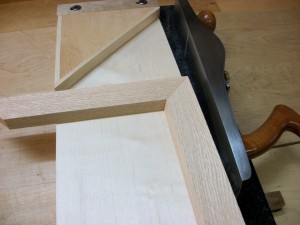 Miter joints shot straight and true
 The "Super Chute" and accessories by Tico Vogt. I just sent my third prototype of a ramped shooting board to Ron Brese (www.breseplane.com). He has been very encouraging in e-mail exchanges over the last month about this project of mine to develop a high quality ramped shooting board with attachments for sale on my website. With the upcoming Lie-Nielson Hand Tool Event in Atlanta he’s been quite busy, but yesterday he had a chance to check it out:
“I gotta tell you I’m very impressed with this shooting board. I promptly put the 45 degree angle jig on the board (installed quite effortlessly) and made a 45 degree cut on a piece of maple and set to refine the miter cut. The plane performed so well that the shavings were coming out of the mouth of the plane polished on both sides and this piece of maple is about 7/8s thick. The board is concise and sets up quite nice to the user and the accessories bolt on and off quite easily. Of course having an 8 lb. shooting plane doesn’t hurt either.:)”
Ron will be taking my shooting board to the event May 7th and 8th at Peach Sate Lumber.
I will be getting a page on my site dedicated to the “Super Chute”, as I’ve named it. It features a runway made of three laminations of 1/4″ MDF , to ensure flatness,covered with a 1/4″ plate of UHMW for the contact surface. The bottom 3/16″ of the plane sole bears against acrylic covered with UHMW tape. The body of the ramped board is MDF veneered in maple with solid lippings. A maple cleat runs under the front edge and the whole unit is easily held between bench dogs. An advantage to the ramp, in addition to the fact that it distributes wear over the cutting edge, is that a clamp can fit unobtrusively inside the front cavity and be out of the way. This Super Chute is very well made, for precision shooting, and intended to compliment the high quality planes being made today. My “Super Chute” page will have detailed pictures, videos, and ordering information. Left-hand versions will also be available!For now please contact me at ticovogt@gmail.com or call 518-584-0641.
The Super Chute will be offered for $215.00, with the miter fence. The additional Donkey Ear attachment for planing in the thickness will be $45.00.
Many individuals have been helpful in my efforts here. Reading Derek Cohen’s excellent blog and Robert Wearing’s “Hand Tools for Woodworkers,” as well as personal e-mails from Ron Brese, Tom Fidgen, Rob Hanson, George Walker, Konrad Sauer, Matt Hodgson, and David Charlesworth.
Thanks to one and all.
 The molding profile I wanted for the top was not readily gotten from router bits, so the block plane was the tool for the job. The shape was drawn on each corner and the end grain worked first. On the exit side of the board I worked to the shape and there was then no “spelching”as the plane moved to that edge. Very pleasant work. The molding profile I wanted for the top was not readily gotten from router bits, so the block plane was the tool for the job. The shape was drawn on each corner and the end grain worked first. On the exit side of the board I worked to the shape and there was then no “spelching”as the plane moved to that edge. Very pleasant work.

  Next up was drilling the holes for the dowels to pass through the shelves and into the underside of the top. For this I made a jig with bushings. Once the shelf holes were drilled I then re-drilled them, but not the top, with a fractionally larger bit. Next up was drilling the holes for the dowels to pass through the shelves and into the underside of the top. For this I made a jig with bushings. Once the shelf holes were drilled I then re-drilled them, but not the top, with a fractionally larger bit.
 Finishing would obviously need to be done prior to assembly. With all these parts it seemed a good idea to have a tidy system to keep them together and without difficulty when applying the rust stain and finish. For the leg pieces I made a stand with vertical dowel supports and spacers, and for the shelves and tops I made frames with small screws protruding. Finishing would obviously need to be done prior to assembly. With all these parts it seemed a good idea to have a tidy system to keep them together and without difficulty when applying the rust stain and finish. For the leg pieces I made a stand with vertical dowel supports and spacers, and for the shelves and tops I made frames with small screws protruding.
 Making spacers  Drilling out spacers 
 Applying rust stain to legs There needed to be precision in the length of dowels prior to clamping the piece together. Dowels would be glued into the tops of each block to a particular depth. I cut a thinner diameter dowel to a certain length, inserted it into a block and tapped a glued dowel from above until it bottomed out against it.
 Dowel depth stop The assembly process went well. Remember that forty-five degree line that I had scribed on the top end grain of the leg blocks? In the clamping stage it was the reference for the blocks to be positioned. : tape with pencil marks on the shelves and legs. The first round of clamping was with the top upside down and the top course of blocks. Afterward it was shelf and blocks. What I found was that the clamps needed to be moved very slightly to position the force so that, with a raking light from behind, there was no light where the blocks and shelves met. Very slight adjustments to the clamps made an important difference.
 Marking inner corner registration points  Clamping top leg blocks  Clamping on feet Finally the little stand stood proudly and squarely on its feet, awaiting its first load of documents, assignments, invoices, or, who knows?
 Desk organizer jigs and fixtures
Some custom woodworking jobs have been rewarding artistically, some financially, some have brought me in contact with intriguing people, others have delivered abundant servings of humble pie, and a select few have been quite bizarre, namely this one.

Several years back local sculptor and artist Alice Manzi (www.manzisculpture.com) commissioned me to make a fourteen foot tall cross. She herself had been commissioned by a new Catholic church in New Jersey to design and build several full scale liturgical settings, one of them being the Crucifixion. It required a large wooden cross to look appropriately textured, hewn, not smooth. The cross could not be two solid timbers notched and nailed, however. The new church floor would have built-in metal sleeves at different stations. The cross needed to be constructed as hollow boxes with a discreet, unobvious access door in the back. There would be a metal pole strapped inside that would drop into the floor sleeves. Reducing the overall weight was another important consideration.
The woodworking and joinery challenge appealed to me. I used some long, clear boards of Aspen, and once the boxes were assembled and the lapping crossing joints finished, I went over the whole structure with an axe to simulate the hewing process, and an antique plane whose blade I shaped into a large “scrub” profile.

I figured that, at that point, the job was done, and all that remained was to deliver it and get the almighty final check.
Some personal background. On my mother’s side of my family the Catholic faith ran deep through Cosgroves and Ballous. My grandmother worked internationally for Catholic Relief and through her I met many Monseigneurs, Bishops, and maybe some Cardinals. As a child I was exposed to a heavy dose of Roman Catholicism. When I got old enough to call my own shots I firmly and consciously put it in the rear-view mirror.
The afternoon for delivery came and I drove across Saratoga in my pick-up truck with the large cross, no doubt engendering a few curious glances. On my delivery days you can count on some kind of threatening weather. That afternoon the atmosphere was close, muggy, with rain impending and angry bugs biting. I reached the studio, set back in the wooded foothills of the Adirondack Mountains, just as raindrops began falling.
Alice and I carried the cross inside and placed it on the floor. I knew the job had been done well, to the specifications, and yet I sensed that, perhaps, there was something bothering Alice, who is a very easy, congenial person. She seemed to be a bit “off”, shall I say. Well, it finally came around that she needed help. The job wasn’t over. What remained to be done was…
A bit more background here. When Alice began work on the sculpture of Christ she consulted a world renowned expert on crucifixion. He furnished her with a thorough analysis of the physical processes the human body endures while undergoing the worst, most insidious torture devised by man. Thus, her sculpture was, as the church commissioners wished, very authentically “life like.” I will spare readers the information I obtained in discussing the subject with her.
… to nail Jesus to the cross.
So, you’re a pro, and there’s a job to do. “What size diameter are the spikes? How should they be angled?” Pull the hand up a bit, swing the feet over a little. Careful not to strike too hard, damn, woops. Hey, don’t break the fiberglass. The room is steamy, Alice is not a happy camper. Sweat is pouring off of my forehead onto my hands. Never had to place a fastener through a gaping wound before. Jesus… Christ, what did I just say?
That was an environment I was all too pleased to put in the rear view mirror.
When I pulled into the driveway at home, instead of taking the tools directly into the shop I uncharacteristically took off for a brisk walk down the lane. All of a sudden words that had not been uttered for decades forced themselves from my lips: “Lord, I am not worthy that Thou should come under my roof. Speak but the word and my soul will be healed.”
 The fun part of this design is making the legs appear to go through the shelves. The method I settled on is doweling, again inspired by Krenov who used them in his cabinetwork. Looking ahead to the assembly stage makes you realize that you need a way to faithfully track the individual leg pieces and have them stay in the right alignment. Also it should be noted that wood movement in this situation could be a problem because if the shelves expand in thickness the force will be in line against the glued dowels. If they shrink in thickness, gaps can appear. The work was done at the lowest cycle of humidity of the year, I’ve kept the shelves 1/4″ thick, and am hoping they wont thicken up appreciably during the summer. The fun part of this design is making the legs appear to go through the shelves. The method I settled on is doweling, again inspired by Krenov who used them in his cabinetwork. Looking ahead to the assembly stage makes you realize that you need a way to faithfully track the individual leg pieces and have them stay in the right alignment. Also it should be noted that wood movement in this situation could be a problem because if the shelves expand in thickness the force will be in line against the glued dowels. If they shrink in thickness, gaps can appear. The work was done at the lowest cycle of humidity of the year, I’ve kept the shelves 1/4″ thick, and am hoping they wont thicken up appreciably during the summer.

 
Here’s how the process went for the legs. They were prepared into rectangular blanks, marked and numbered, crosscut into sections, and holes drilled for dowels. One key step was to mark a forty-five degree line on the top of each section from the center to the inside corner. This was the reference for later assembly. Also, a small nail hole was drilled along that line and inside of the eventual leg circumference. These temporary, removable nails provided a way for the blanks to stay fixed and not rotate around the dowel when the shaping was done.
 
As the pictures show, a nail was placed into the first block, placed against a stop, and the next block above it tapped tightly against it. After that process I inserted temporary dowels that were sanded in the drill press to be fractionally smaller. Then the blocks were assembled, taped together, and the layout lines drawn on for band sawing. After that they were put in between some puppets and further layout lines drawn. The drawknife, spokeshave, block plane, file and sandpaper process brought them to their final shape.


 After drawknife and spokeshaves  Exploded leg  Next time: shaping the top, finishing, and assembly. Next time: shaping the top, finishing, and assembly.
 Everything starts from an inspiration. Inspired by practical necessity, financial need, creative concept, or various combinations thereof, we then set out to make something. In the case of this recently fabricated desk organizer I was inspired to improve upon a piece I had made once before (creative) and also to begin to use up some short “leftovers” that have accumulated (practical). Everything starts from an inspiration. Inspired by practical necessity, financial need, creative concept, or various combinations thereof, we then set out to make something. In the case of this recently fabricated desk organizer I was inspired to improve upon a piece I had made once before (creative) and also to begin to use up some short “leftovers” that have accumulated (practical).

 From my earliest days in fine woodworking I’ve been inspired by the work of the late James Krenov, by both the actual pieces he created and his philosophy of satisfying your individual creative ideas. Another strong influence has been the small book “Chinese Household Furniture” by George N. Kates published in 1948. Both of these sources came into play when this design developed. From my earliest days in fine woodworking I’ve been inspired by the work of the late James Krenov, by both the actual pieces he created and his philosophy of satisfying your individual creative ideas. Another strong influence has been the small book “Chinese Household Furniture” by George N. Kates published in 1948. Both of these sources came into play when this design developed.

A couple of years ago my wife, Courtney, asked me if I would make her an organizer for her desk at the college where she teaches five (you heard that correctly, five) writing and literature courses. A shelf for each class’s papers. What came together was made up of a spalted elm board that was lying around, some 1/4″ plywood scraps, and scrap poplar L channel I had made for door casing trim which became legs. Except for the elm everything got painted black. The piece was a success. Since that time I’ve wanted to try my hand at a different design. The dimensions and proportions seemed okay on the first organizer and I used them as a general guideline, but did change the space between the floor and the first shelf. A full rendering on paper involved a little more tweaking. The leg curves took a few goes around but eventually looked good to me. I made a mock up in poplar and settled on what was drawn. Having the full scale drawing helped clarify how the joinery would work.
 So, what follows will be a step-by-step account of how I went about turning an inspiration into the object just photographed. So, what follows will be a step-by-step account of how I went about turning an inspiration into the object just photographed.
 Right off I addressed the shelves and top. You want things like shelves and tops to be flat as a general rule, but in this case their flatness is critical. The top was a wide board, the shelves book matched from narrower boards. After planing them (note the winding sticks) and thicknessing, they were stickered and left to move around while the rest of the work proceeded. Right off I addressed the shelves and top. You want things like shelves and tops to be flat as a general rule, but in this case their flatness is critical. The top was a wide board, the shelves book matched from narrower boards. After planing them (note the winding sticks) and thicknessing, they were stickered and left to move around while the rest of the work proceeded.

More anon.

Why a woodworker Part 3 Final
“I derive a certain pleasure from an awareness of our gift of wood. Beside giving me it’s chemical and utilitarian benefits, like the fireplace that ‘warms the soul as well as the body,’ the tree and its wood are a most necessary part of my life’s aesthetic enjoyment.” (Eric Sloane, A Reverence For Wood, Author’s Note)
The aesthetic feeling for wood furniture was passed from Curly Ballou to his daughter, my mother, Frances Anne. When my parents were married in 1946, my father commissioned a set of classic Hitchcock chairs. 
 
They were custom stenciled by F.W. Hunter in New Milford, Connecticut. They currently grace our homemade dining table.  It’s odd that these traditional chairs work with a modern design (in my view). The stenciling has faded and almost goes unnoticed, but the painted curves of the leg posts and back splats compliment the curved legs of the table and the edges of the top. They are too delicate for today’s sitters, though. I hope someday to study with Peter Galbert and make my own chairs. It’s odd that these traditional chairs work with a modern design (in my view). The stenciling has faded and almost goes unnoticed, but the painted curves of the leg posts and back splats compliment the curved legs of the table and the edges of the top. They are too delicate for today’s sitters, though. I hope someday to study with Peter Galbert and make my own chairs.
To complete my three part post on “Why a woodworker” I’ll present photos of and comment on six more pieces of furniture that I grew up with which have come down to our family.
The first is this dough box.  Growing up, I knew this as a stand for our family television. My mother did educate me as to it’s original purpose (while I munched on Twinkies, most likely). What eventually dawned on me were the joints, dovetails, the geometric shape, a hopper, and the wide, knot-free pine boards. It was clearly made in a remote time when people used their hands to make necessary items for their daily sustenance and their available material was lumber from huge trees. Growing up, I knew this as a stand for our family television. My mother did educate me as to it’s original purpose (while I munched on Twinkies, most likely). What eventually dawned on me were the joints, dovetails, the geometric shape, a hopper, and the wide, knot-free pine boards. It was clearly made in a remote time when people used their hands to make necessary items for their daily sustenance and their available material was lumber from huge trees.
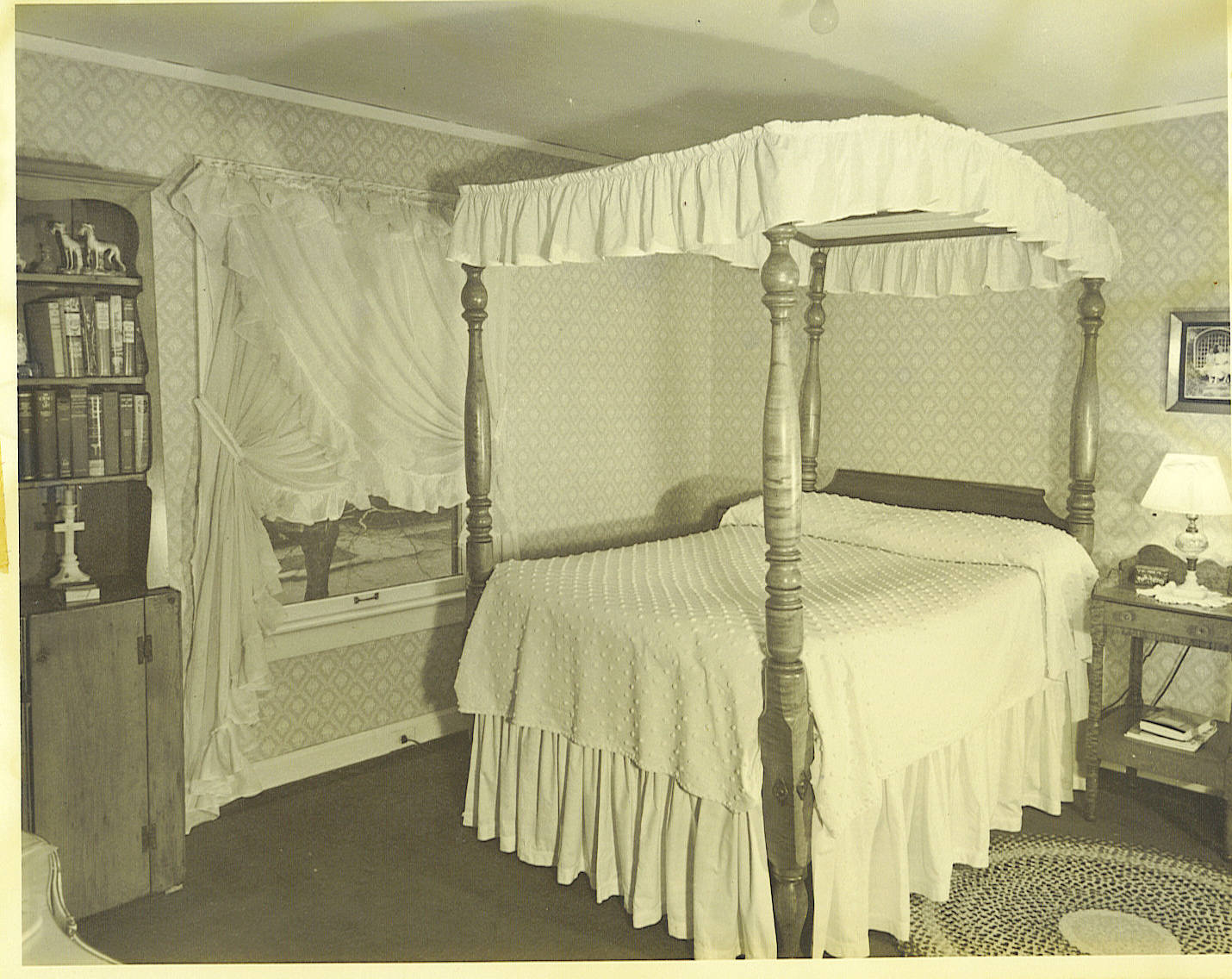
Not everything made in earlier times had to be of strict utilitarian design. These maple bed posts from the bed in my parents’ room had really interesting turnings and there were slight variations from one to the other. I must have run my hands over these shapes thousands of times.
My mom referred to this next one as a “pail bench.” Coming in from the barn the farmer would put his recently filled milking pail on it. My grandmother used it as a coffee table in front of her couch, which she called a “divan.” I like the simple semi-circular cut-outs and the splayed ends. Even simple day- to- day objects had some flair.
There was more flair on the contoured shape of this mirror.

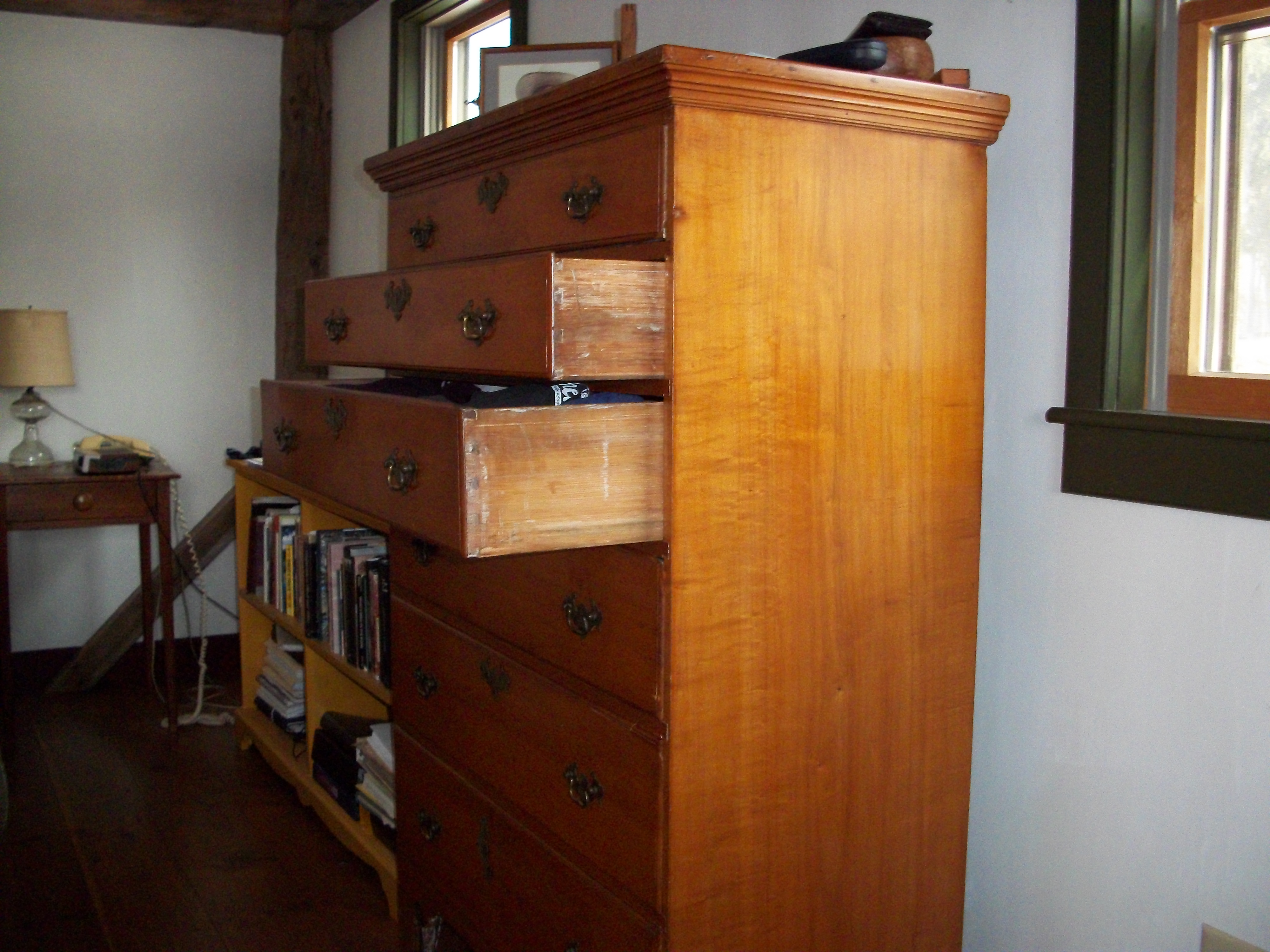
The plinth of this chest of drawers works very effectively to offset the straight rectangle of this chest of drawers.

Lastly, there is a “tavern table,” as my mother called it. It has a very wide, single board top, tapered legs with edge beading and a single, centered flute, and a whittled drawer pull. In its time I imagine that friends pulled up to this board and shared food, stories, and discussed the events of the day. Today an appliance rests on top of it which allows me to share stories (no food, but recipes) with people around the globe. While sitting by it I so often examine the hand shaped edges, run my finger tips over the protruding square nail heads, notice the seasonal wood movement as the thirty inch wide top shrinks or expands relative to the breadboard ends( which it has done for … a couple hundred years?) and feel an incredible gratitude to be involved in the age old tradition of woodworking. In its time I imagine that friends pulled up to this board and shared food, stories, and discussed the events of the day. Today an appliance rests on top of it which allows me to share stories (no food, but recipes) with people around the globe. While sitting by it I so often examine the hand shaped edges, run my finger tips over the protruding square nail heads, notice the seasonal wood movement as the thirty inch wide top shrinks or expands relative to the breadboard ends( which it has done for … a couple hundred years?) and feel an incredible gratitude to be involved in the age old tradition of woodworking.

Why a woodworker. Part 2.


My maternal grandfather, Clarence. M. Ballou, was born in North Adams, Massachusetts. The Ballous were one of the earliest New England families. He graduated from Cornell in 1907 with a specialty in Mechanical Engineering. His working career in the steel and railroad industries began in Braddock, Pennsylvania, where he married my grandmother and started a family. In the1930s he became Vice President and General Manager of the Cleveland Railway Corporation, later President of the Steel Warehouse Association in Cleveland, and at the time of his death Vice President of the American Creosoting Company.
I’m lucky to be in possession of his college scrapbook when he was a Cornell student. It is filled with theater reviews and playbills of both college dramatic productions as well as items from the New York stage. He loved the theater and acquired the nickname “Curly Ballou”which was a take off on a leading actor of the day, Kerle Bellew.
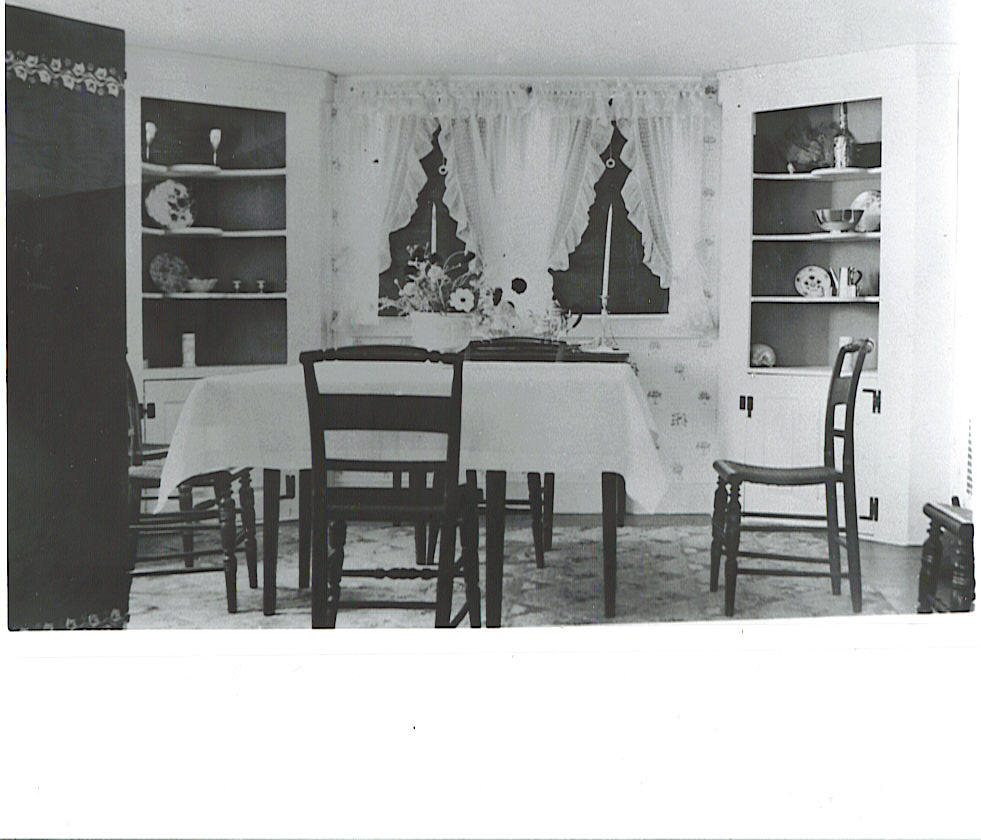
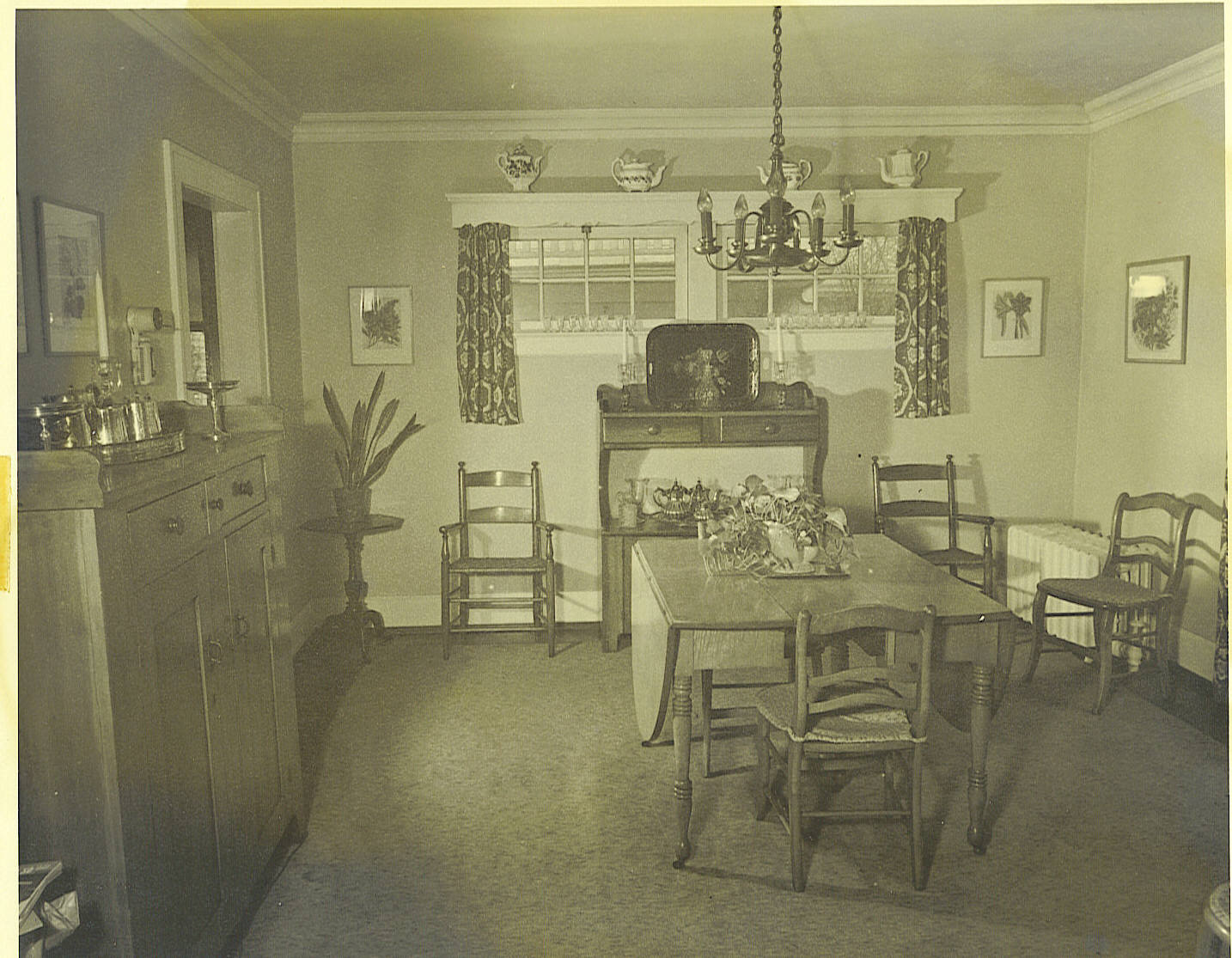
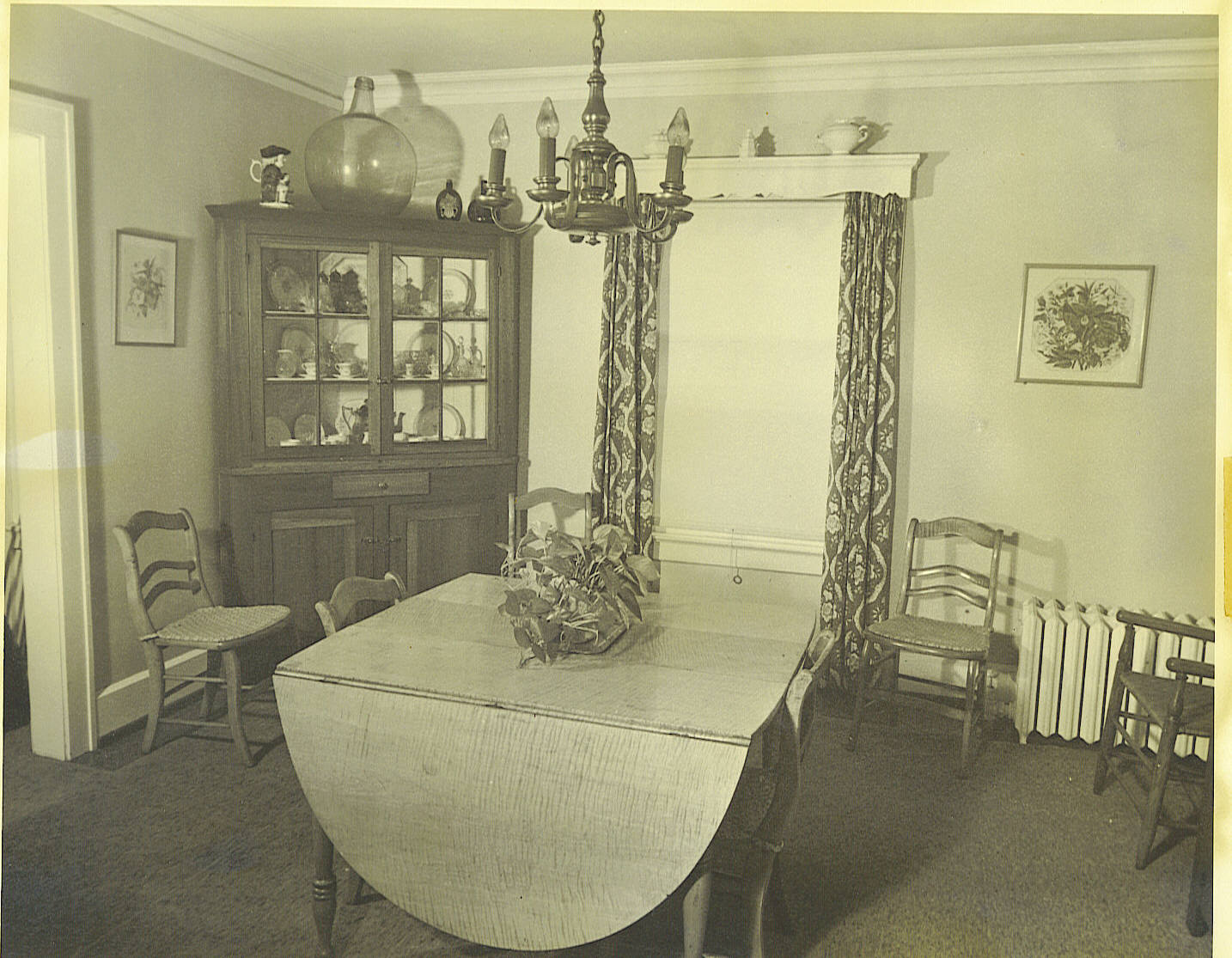
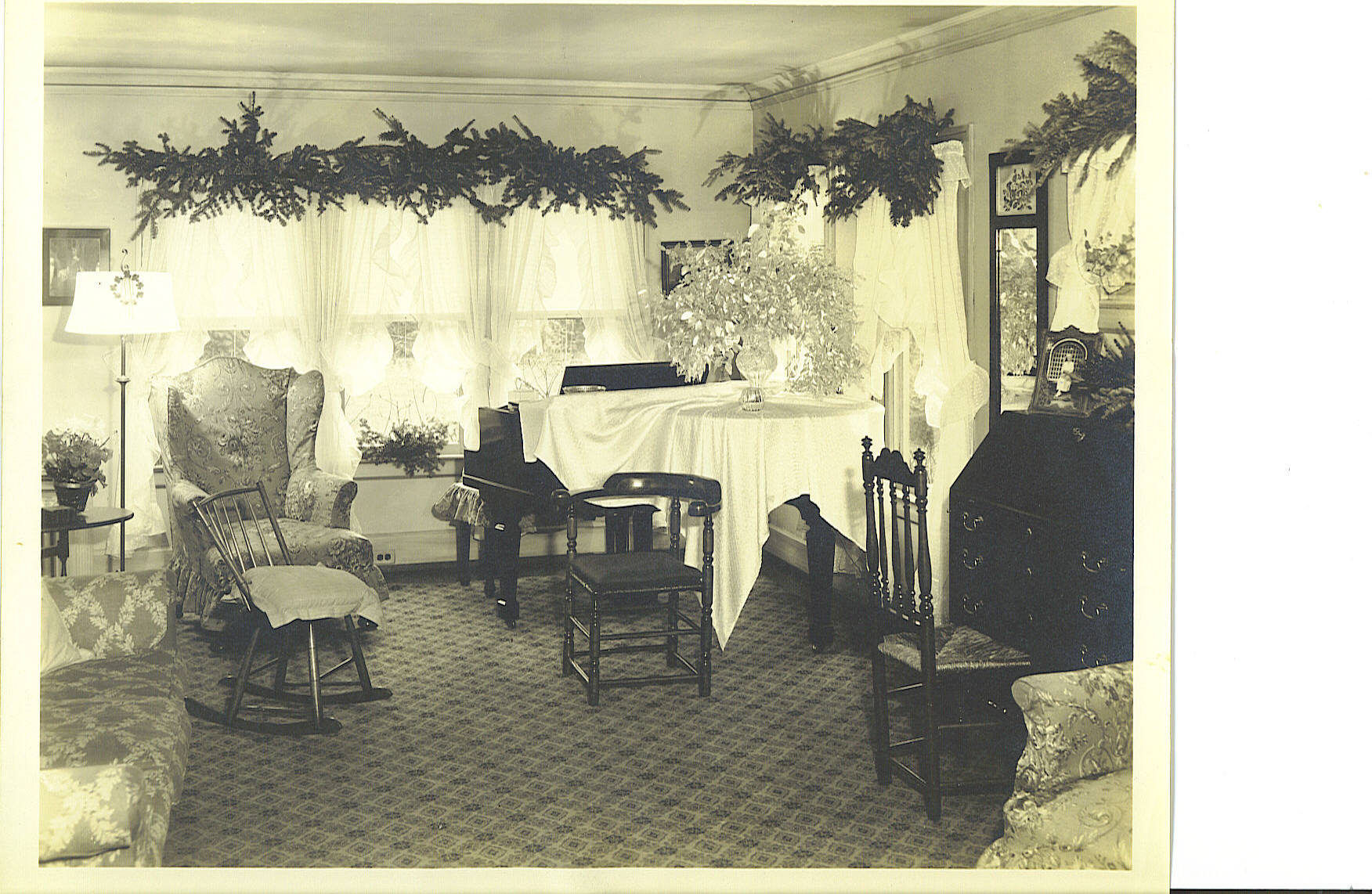
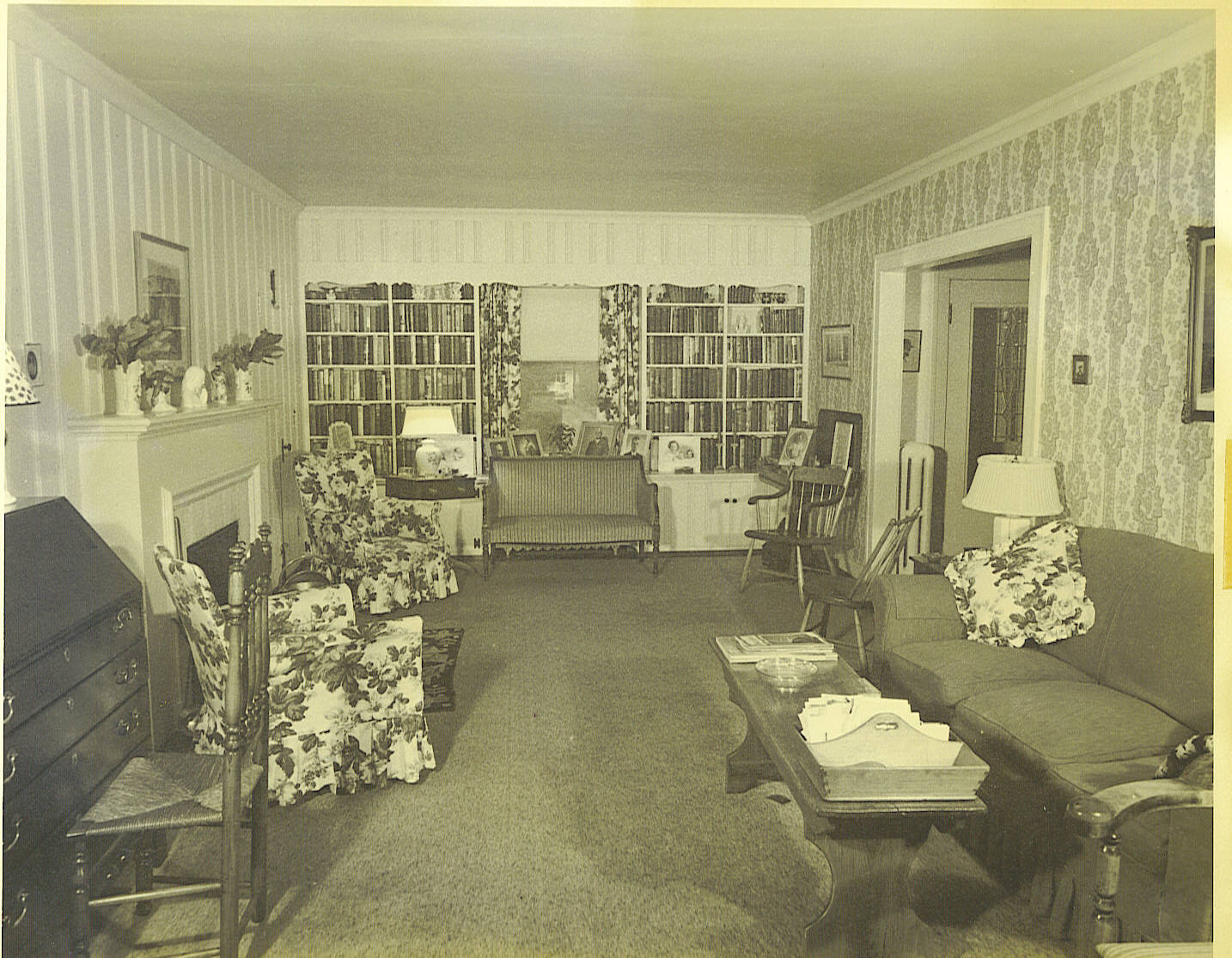
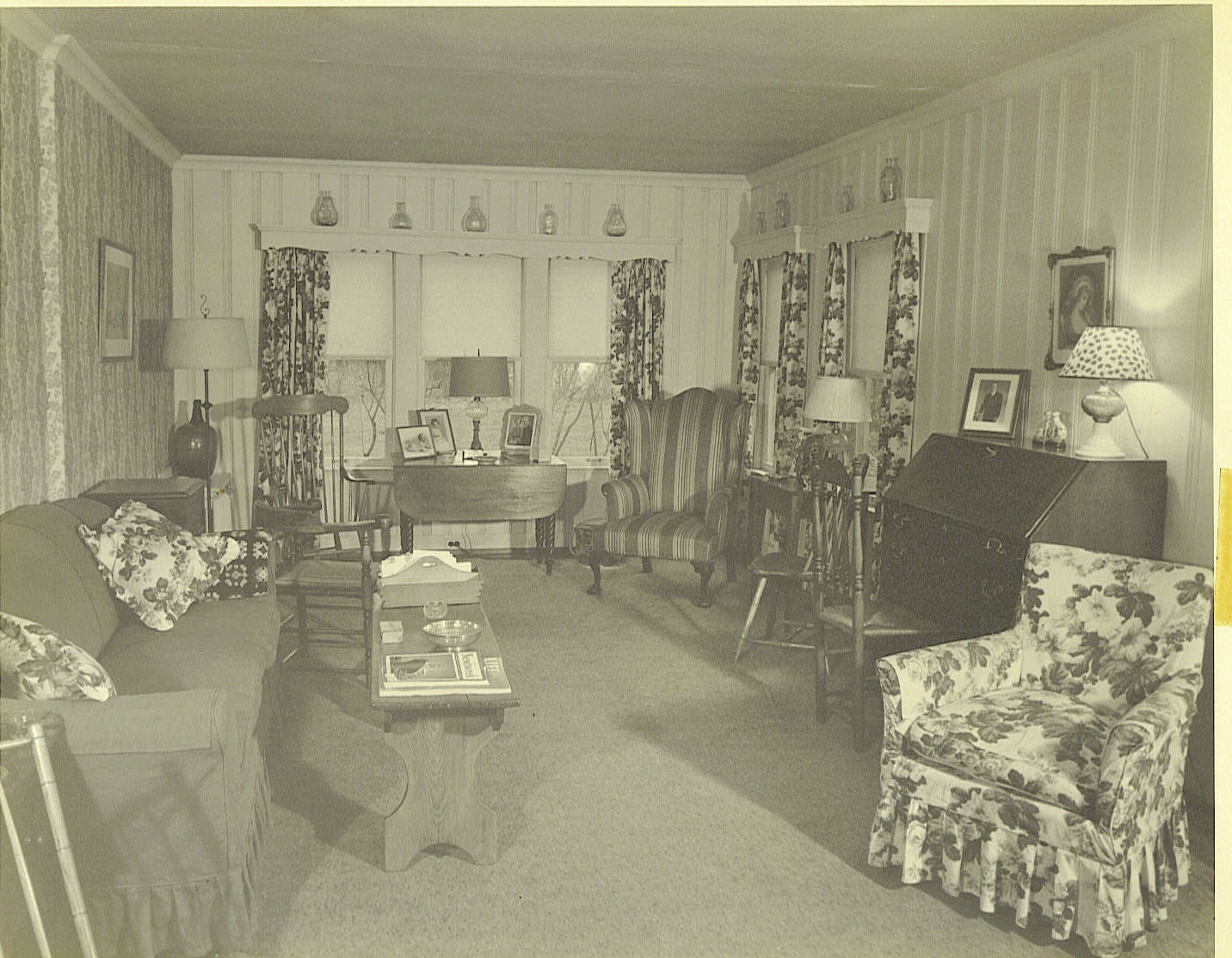
As I mentioned in the previous post, I never knew him, so all the anecdotal personal information about him I picked up from my grandmother and mother. In addition to his love of theater was a love of furniture. You’ll see in the following pictures very fine portraits of room settings in my grandparents’ home in Cleveland. According to my grandmother, he personally restored quite a number of old pieces, many of which he found being discarded on the curb, covered in paint.
(Click on any image to enlarge)
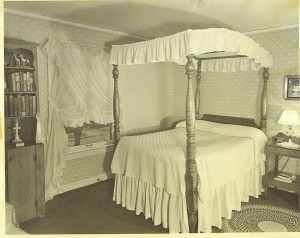 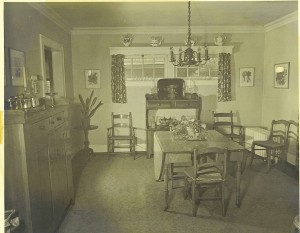 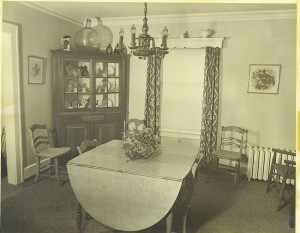 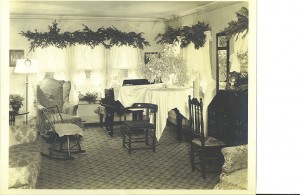 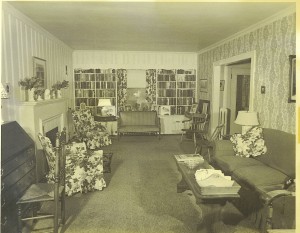 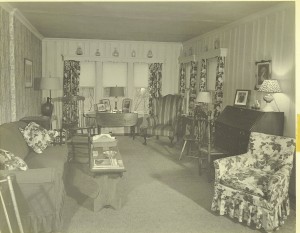 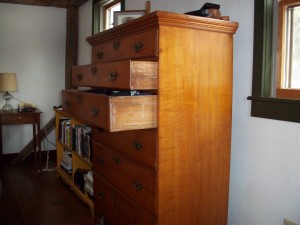
I have often considered what it was like to grow up in that time period in America. The exponential growth of post Civil War industrialization changed cities as well as rural landscapes to such an extent that, while there must have been great excitement about progress, there must also have been a sense of what was being lost, overlooked, and no longer considered to be of value. I imagine that Curly had a keen sensibility for the vanishing world of artisan made goods, contrasting so starkly with his professional world in the giant industries of steel and transportation. It would have been a tonic to spend time in a workshop bringing back to simple dignity these useful hand made objects.
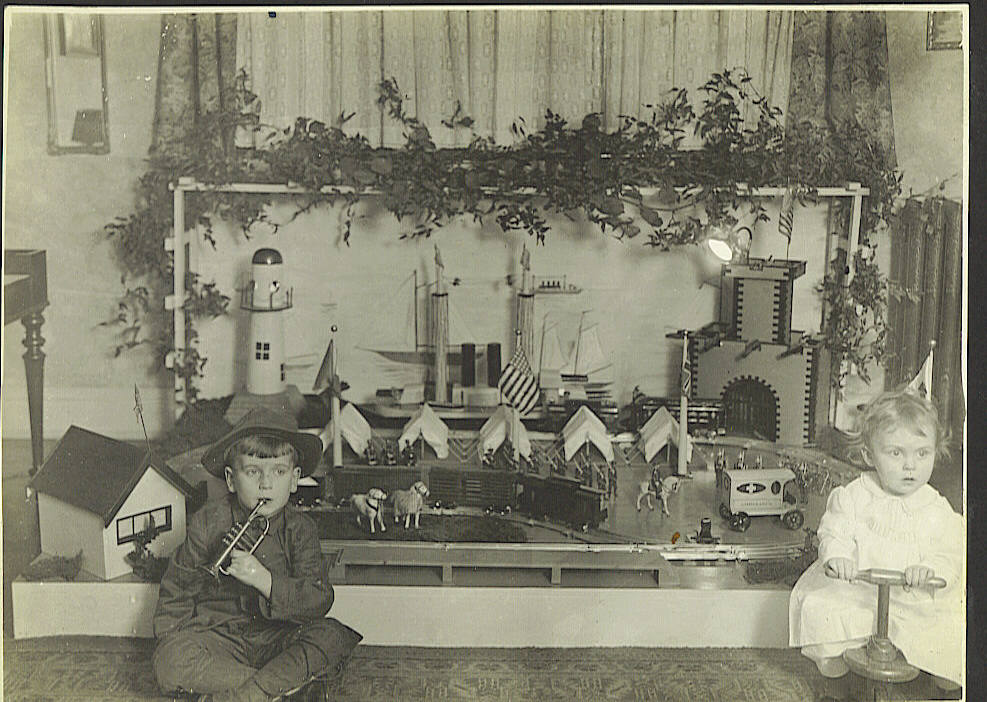
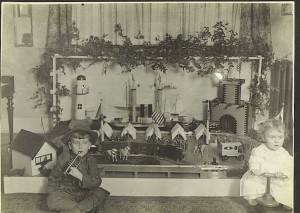
He also took delight in making things, as can be seen in this Christmas present.
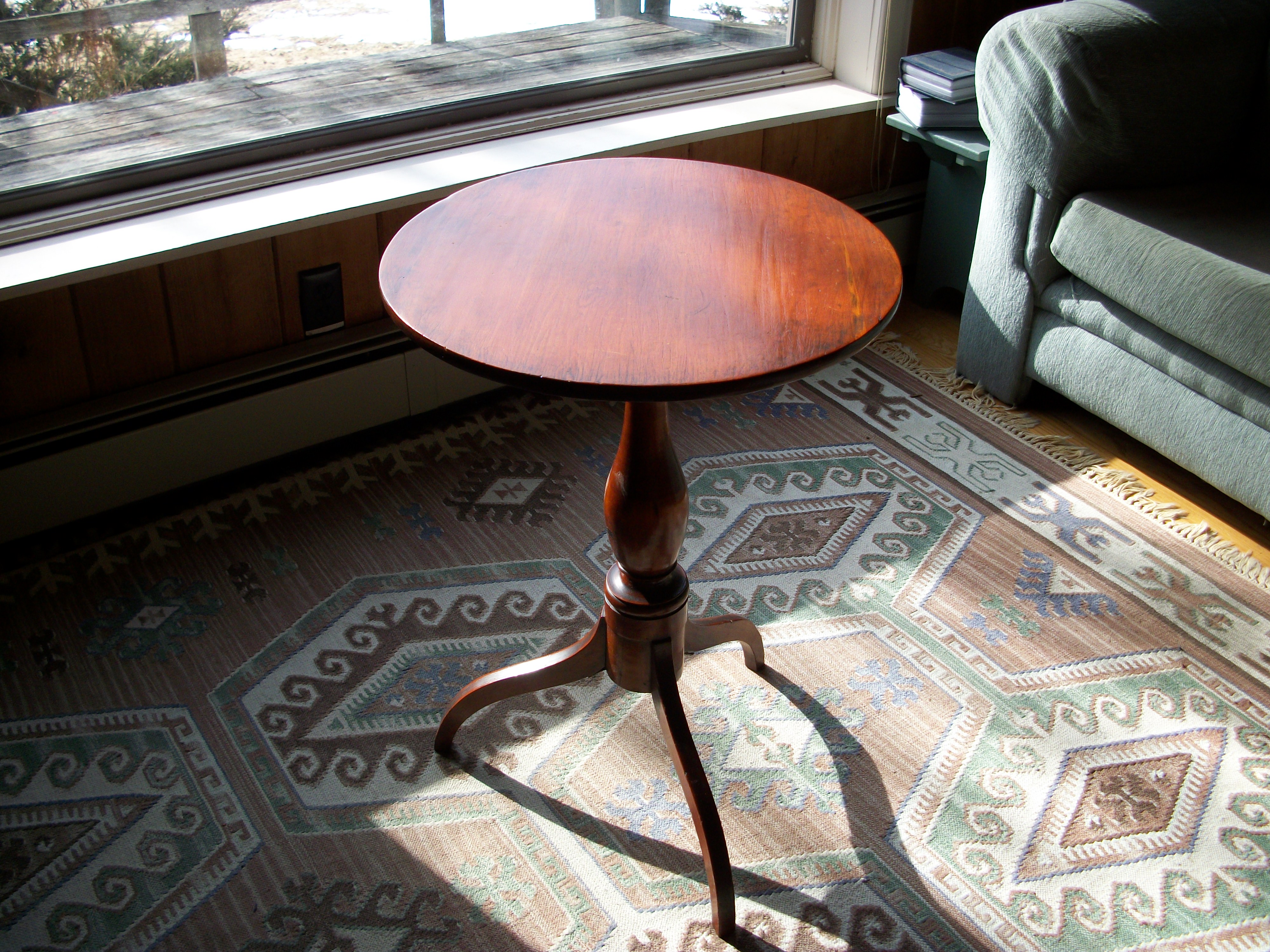
I’ll end this post with a photo of a cherry table that has come to me from my grandparents’ home. I can’t say for sure if he bought it pretty much as is or if he restored it. What I hope the picture shows are the hand plane marks on the top. It wasn’t sanded perfectly smooth and flat. It has a texture, an individual character that catches my interest. It ties in directly to one of my woodworking heroes, the recently departed James Krenov, who encouraged craftsmen to leave their “fingerprints”.
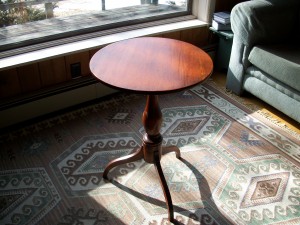
Thanks, Curly, for saving the fingerprints.
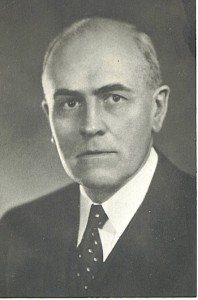 Clarence Maturin Ballou 1886-1948
|
|